



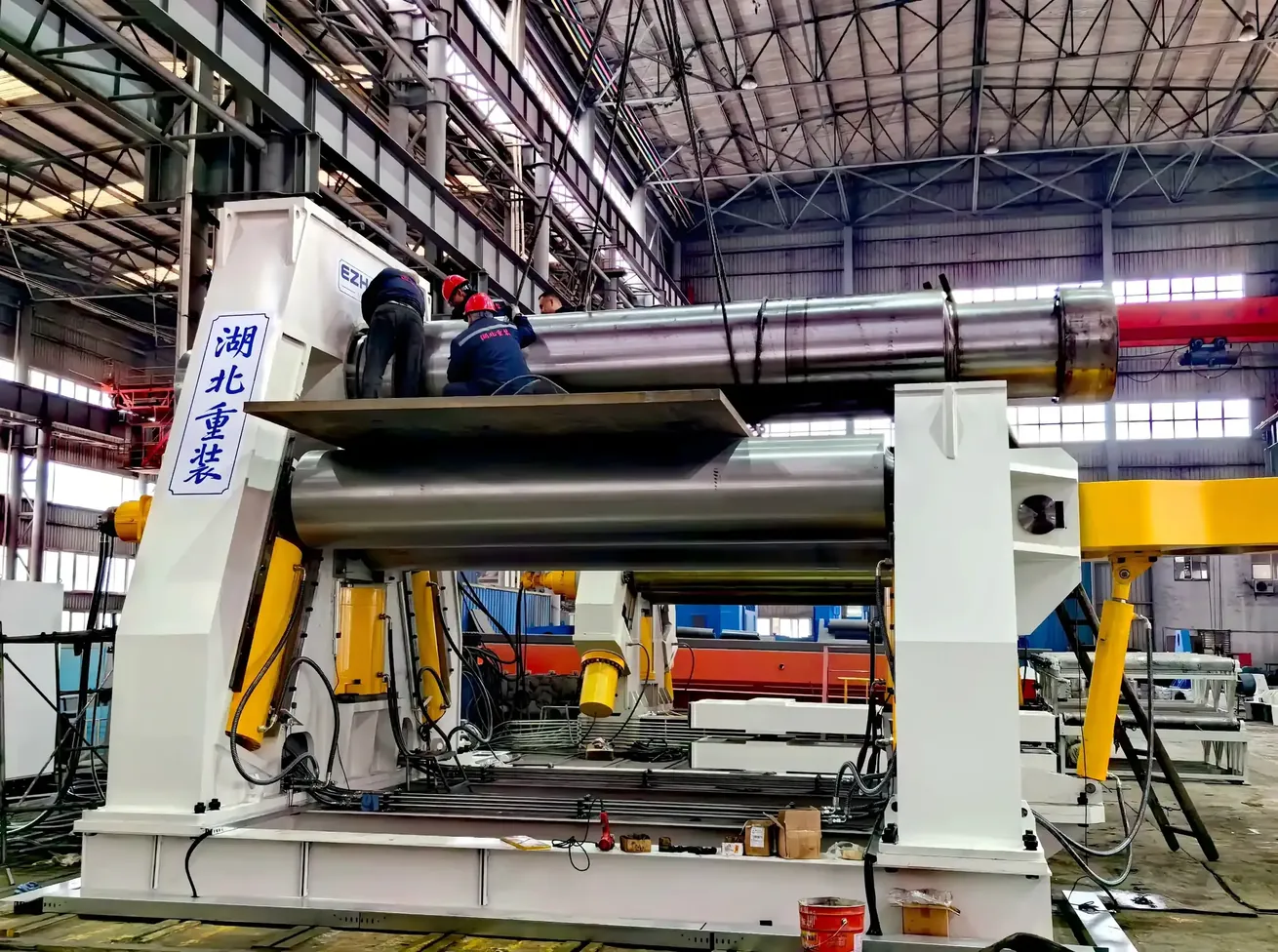
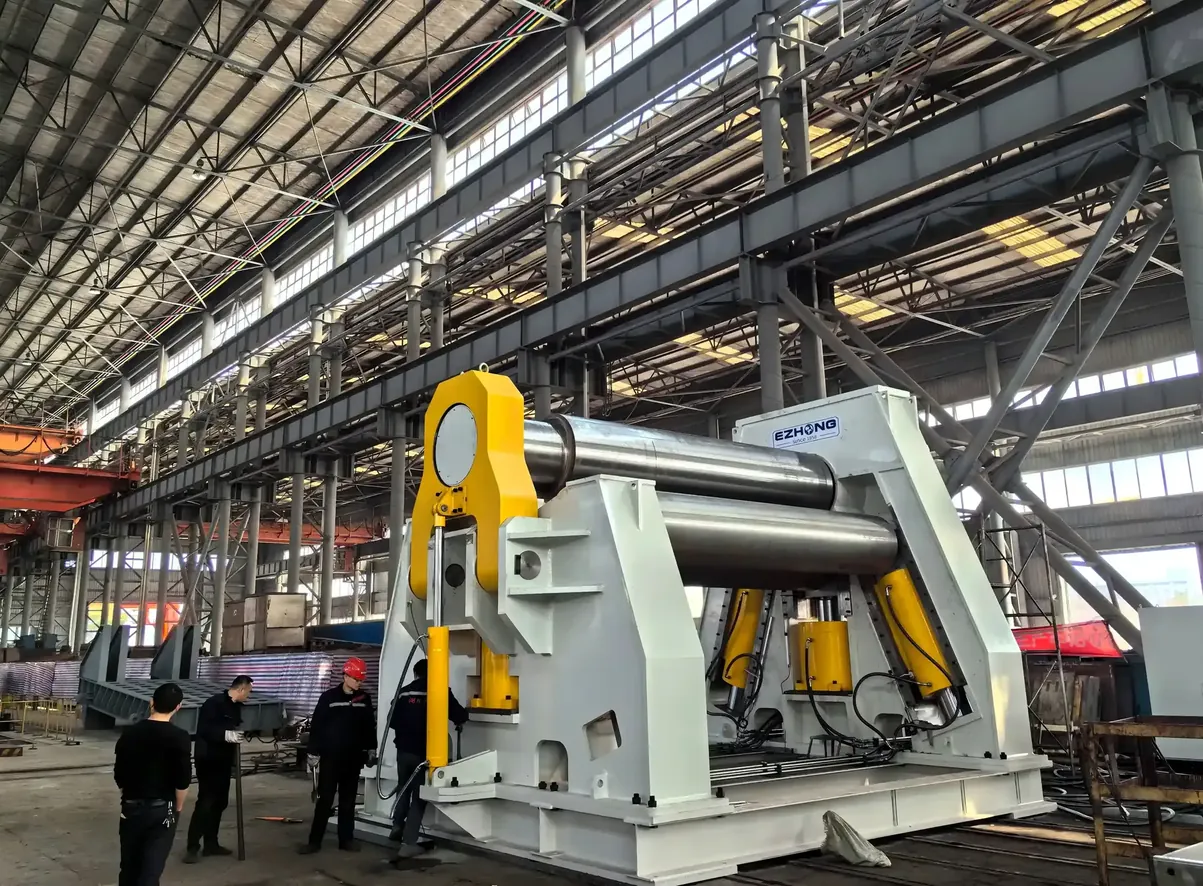
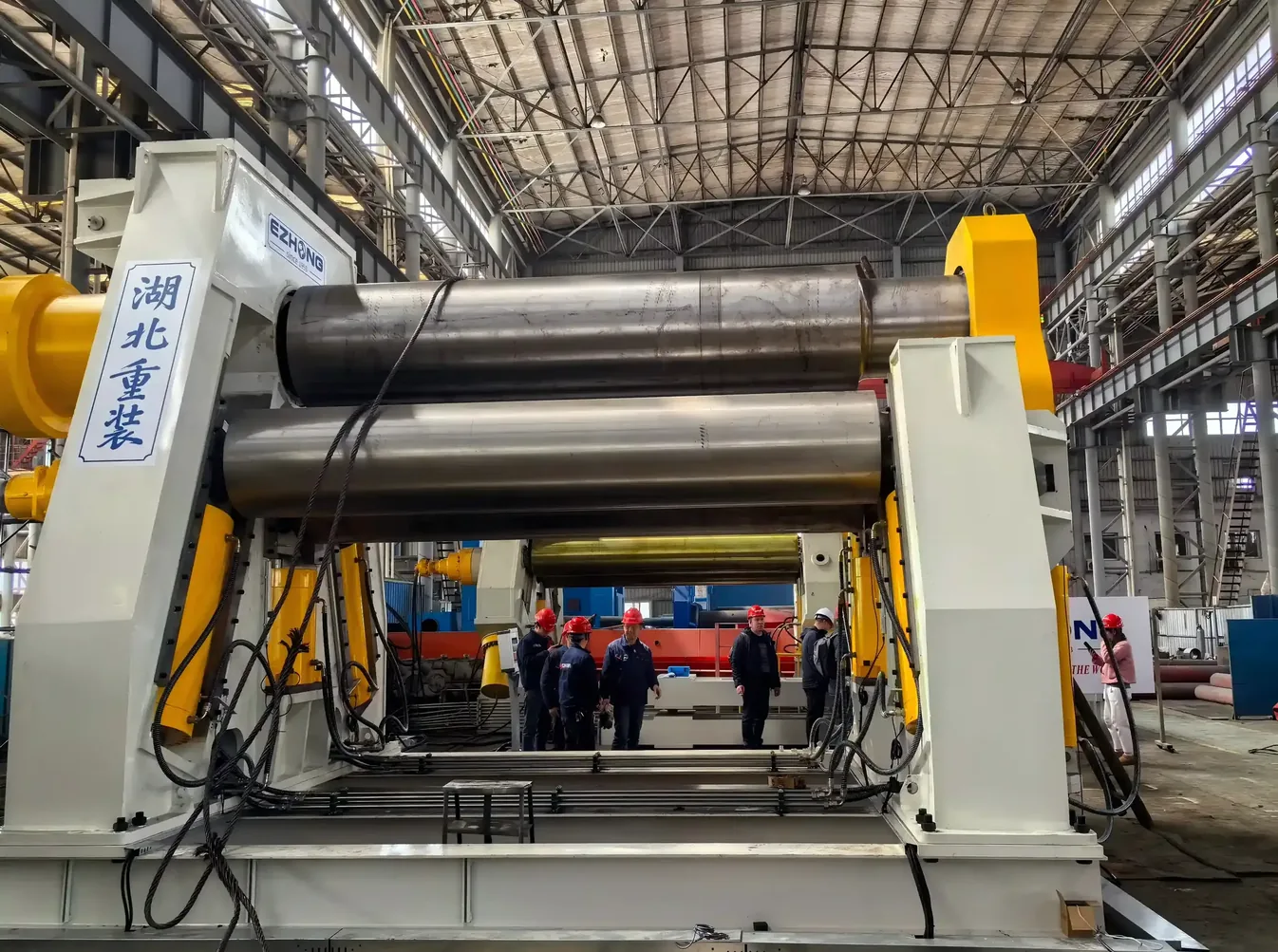
The four-roll configuration clamps the plate between the upper and lower central rolls, allowing end pre-bending and continuous rolling in a single feeding direction. Unlike conventional three-roll processes, the plate does not need to be removed and turned over for end pre-bending.
Key Benefits:One-time feeding for pre-bending and rolling
No plate turning between pre-bending operations
Stable plate positioning throughout the process
Reduced handling and production time
Suitable for NC and CNC automatic operation
The plate is securely clamped between the upper and lower rolls during pre-bending and rolling. Hydraulic control and rapid roll braking help maintain accurate plate-end positioning and minimize the remaining straight edge.
Key Benefits:Reduced plate slipping
Accurate positioning of plate ends
Shorter remaining straight edges
Improved material utilization
More consistent pre-bending results
The adjustable center distance between the working rolls enables the machine to accommodate different plate thicknesses, bending radii, and forming conditions. Roll positions can be precisely adjusted according to the required forming geometry.
Key Benefits:Flexible adaptation to different plate thicknesses
Optimized forming geometry
Improved pre-bending capability
Suitable for different cylinder diameters
Supports cone and special-shape forming
The hydraulic drive system provides stable torque and controlled roll movement during heavy-duty forming. Roll movements are coordinated through the hydraulic and control systems to maintain stable plate feeding and forming accuracy.
Key Benefits:Stable torque transmission
Smooth roll movement
Reliable heavy-duty forming
Accurate roll positioning
Reduced risk of plate slipping
The four-roll configuration provides flexible roll positioning for producing cylindrical shells, conical sections, variable-radius arcs, and other formed components.
Typical Applications:Cylindrical shells
Conical sections
Curved plates
Tank components
Pressure vessel shells
Wind tower sections
Marine structures
Special-shaped components
The hydraulic system integrates roll positioning, balancing, overload protection, and safety functions to ensure stable machine operation. A mobile operator console and digital roll-position display provide clear control of the forming process.
Key Benefits:Hydraulic roll balancing
Overload protection
Real-time roll-position display
Mobile operator console
Simple and intuitive operation
Reliable long-term performance
The four-roll configuration clamps the plate securely between the upper and lower rolls before forming. The plate end is pre-bent while firmly held between the rolls, followed by continuous rolling to the required diameter. This forming principle minimizes plate movement and eliminates the need to turn the workpiece between pre-bending operations.
Processing Benefit:Shorter straight edges, reduced material handling, and improved forming efficiency compared with conventional multi-step rolling processes.
The adjustable roll geometry allows the machine to adapt to different plate thicknesses, bending radii, and forming requirements. Hydraulic roll positioning provides flexible control of the working geometry throughout the forming process.
Production Benefit:Optimized roll positioning improves forming flexibility and enables the same machine to handle a wider range of workpiece dimensions and forming conditions.
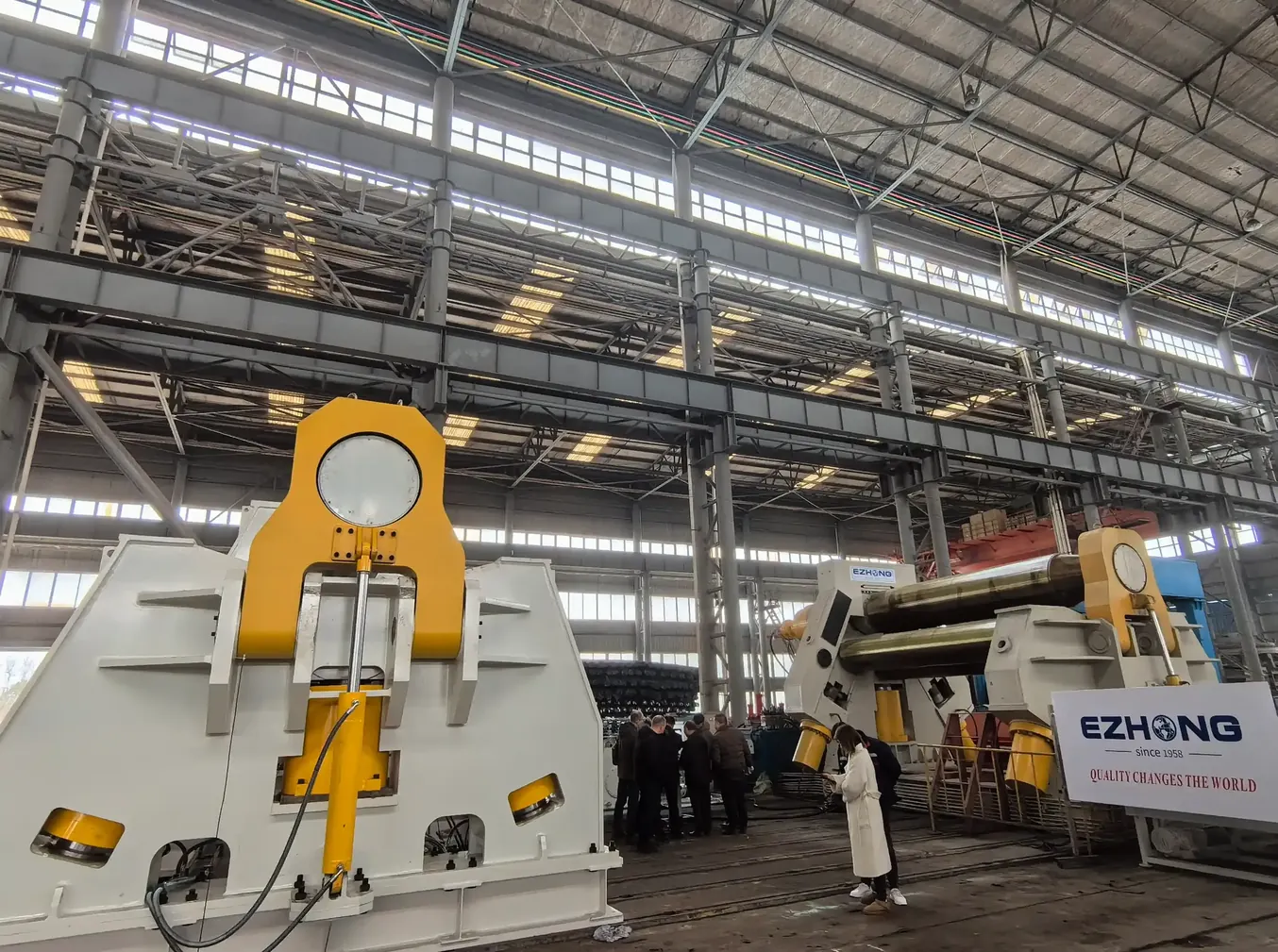
The work rolls are manufactured from high-strength 42CrMo forged alloy steel and undergo quenching and tempering treatment. The combination of forged construction and heat treatment provides the strength, wear resistance, and structural reliability required for heavy-duty plate forming.
Production Benefit:High-strength work rolls maintain stable geometry and reliable forming performance during continuous heavy-duty operation.
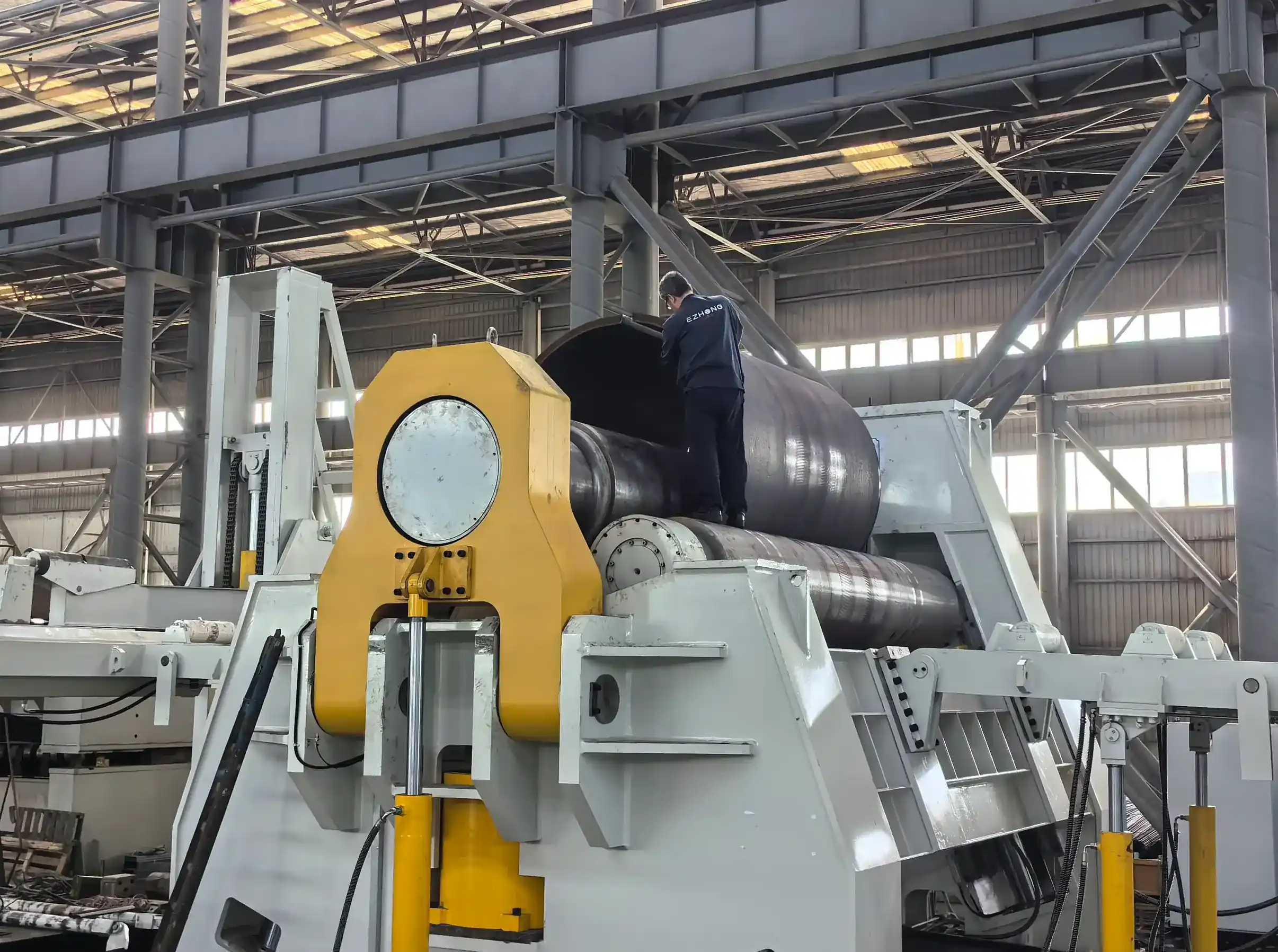
The electro-hydraulic system provides coordinated control of roll movement, forming pressure, roll balancing, and positioning. The PLC-based control system integrates machine operation, parameter management, monitoring, alarm functions, and safety interlocks for reliable and precise forming control.
Production Benefit:Integrated hydraulic and electrical control provides stable machine operation, repeatable forming results, and convenient control of complex rolling processes.
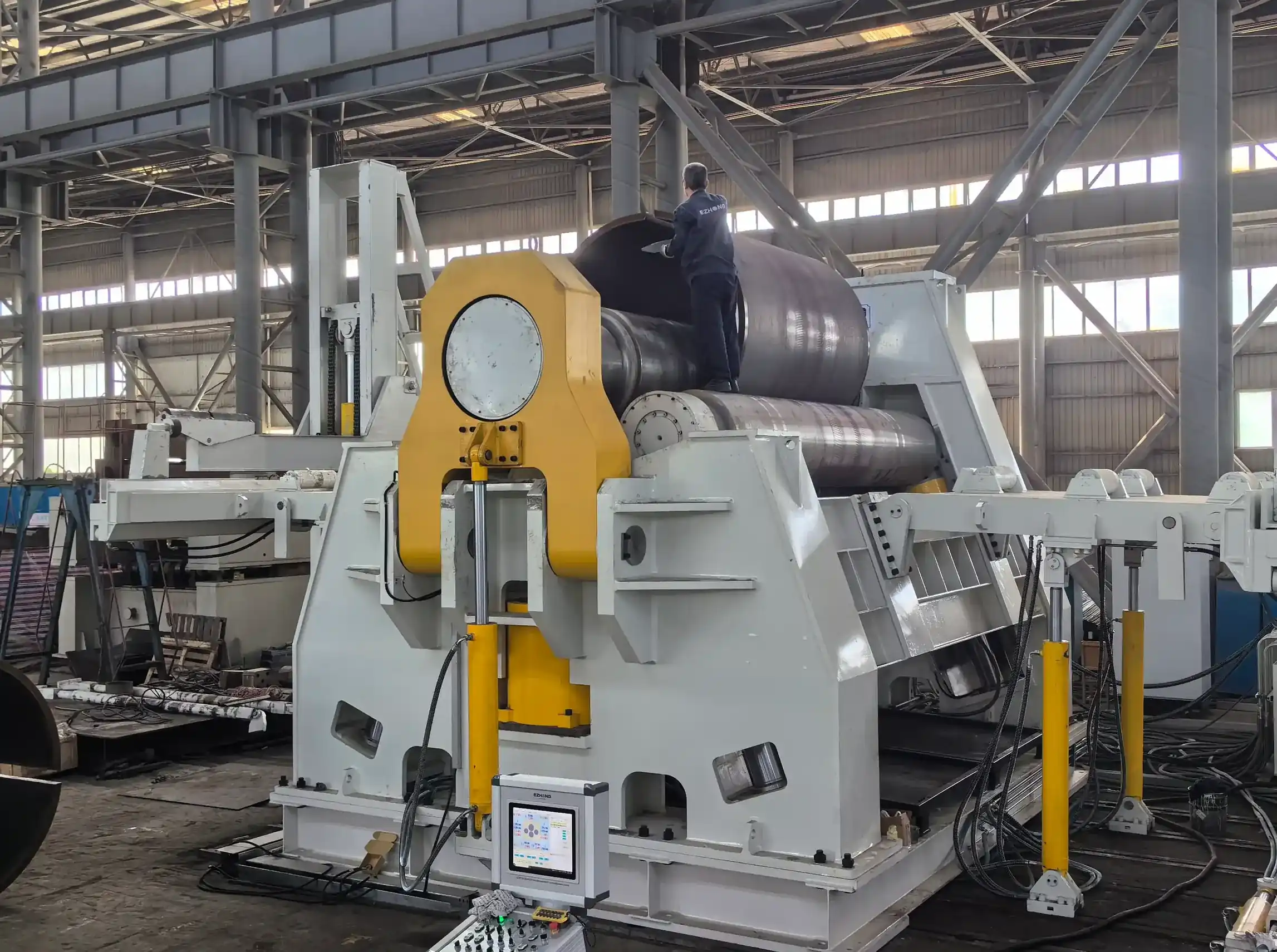
The machine frame and base are manufactured from welded structural steel and subjected to stress-relieving treatment to reduce residual stress and improve structural stability. The integrated base provides high rigidity and facilitates transportation, installation and maintenance.
42CrMo forged work rolls with heat treatment provide the required strength, wear resistance and durability for heavy-duty plate forming.
The hydraulic system independently controls the movement and positioning of the working rolls, providing stable forming force and accurate roll adjustment. Hydraulic balancing and overload protection help maintain reliable operation under demanding forming conditions.
The hydraulic tipping frame allows the machine head to tilt for convenient removal of the finished cylinder. The tipping and resetting movements are equipped with hydraulic interlocking protection to prevent operation before the machine is correctly reset.
| Model | Max Pre-Bending Thickness (mm) | Max Rolling Thickness (mm) | Max Rolling Width (mm) | Main Motor Power (kW) |
|---|---|---|---|---|
| EZW12-10×1500 | 8 | 10 | 1500 | 11 |
| EZW12-12×2000 | 10 | 12 | 2000 | 15 |
| EZW12-16×2000 | 12 | 16 | 2000 | 18.5 |
| EZW12-20×2000 | 16 | 20 | 2000 | 18.5 |
| EZW12-25×2000 | 20 | 25 | 2000 | 22 |
| EZW12-30×2000 | 25 | 30 | 2000 | 37 |
| EZW12-25×2500 | 20 | 25 | 2500 | 37 |
| EZW12-30×2500 | 25 | 30 | 2500 | 37 |
| EZW12-30×3000 | 25 | 30 | 3000 | 45 |
| EZW12-40×3000 | 32 | 40 | 3000 | 55 |
| EZW12-50×3000 | 40 | 50 | 3000 | 55 |
| EZW12-60×3000 | 50 | 60 | 3000 | 75 |
| EZW12-70×3000 | 60 | 70 | 3000 | 75 |
| EZW12-80×3000 | 65 | 80 | 3000 | 90 |
| EZW12-90×3000 | 75 | 90 | 3000 | 90 |
| EZW12-100×3000 | 80 | 100 | 3000 | 110 |
| EZW12-100×3500 | 80 | 100 | 3500 | 45×4 |
| EZW12-100×4000 | 80 | 100 | 4000 | 45×4 |
| EZW12-120×3000 | 100 | 120 | 3000 | 55×4 |
| EZW12-120×3500 | 100 | 120 | 3500 | 55×4 |
| EZW12-120×4000 | 100 | 120 | 4000 | 55×4 |
| EZW12-140×3000 | 115 | 140 | 3000 | 75×4 |
| EZW12-160×3500 | 130 | 160 | 3500 | 90×4 |
| EZW12-180×3000 | 150 | 180 | 3000 | 55×8 |
| EZW12-200×4000 | 160 | 200 | 4000 | 75×8 |
Answer a few quick questions to help us recommend the most suitable plate bending machine for your application.
Aluminum 5000/6000 series (5083, 6061, 6063) | Thickness 8-20mm | Typical Diameter 300-1500mm | Mirror-polish surface finish, zero surface indentation, strain-hardening preserved.
304, 316L stainless steel | Thickness 10-25mm | HVAC ducts, decorative tubes, visible industrial piping | Cosmetic surface quality, no marring, consistent diameter ±1mm.
Duplex 2205, austenitic 316L, titanium alloys | Thickness 8-20mm | Typical Diameter 200-1200mm | Minimal scrap rate (material cost €80-300/kg), no rework allowance.
Copper-nickel (90/10), aluminum bronze | Thickness 6-18mm | Typical Diameter 400-2000mm | Internal bore cleanliness, no corrosion-inducing surface marks.
Stainless steel 304L, austenitic 316L (FDA-approved alloys) | Thickness 10-20mm | Typical Diameter 300-1000mm | Passivation-ready surface (no iron contamination), sanitary tube geometry.
Aluminum alloys (6061-T6) | Thickness 8-16mm | Typical Diameter 400-800mm | No surface defects post-weld, fatigue-resistant geometry.
Challenge:Previous 3-roll machine produced aluminum tubes with ±2-3mm surface indentation. Scrap rate 8-10%; customer rejected 12% of orders. Specialty aluminum 6063-T6 difficult to process without material degradation.
Solution:Deployed EZW12X-20×2500 with hydraulic pressure-balanced upper roller and dual-speed system.
Result:Surface Quality eliminated indentation; achieved mirror-polish finish (Ra ← 0.8μm). Scrap Rate reduced from 8-10% → 1.2%. Customer Acceptance improved from 88% → 99.5% first-pass quality. Material Yield improved from 92% → 98.5%.
Challenge:Manufacturing 316L stainless tubes for pharmaceutical equipment. Manual surface inspection took 30 minutes per 100 tubes; scrap loss 6% due to undetected surface marks. Customer (major pharma OEM) rejects any tubes with visible surface defects.
Solution:Integrated EZW12X-25×3000 with advanced position monitoring + integrated in-line visual inspection station.
Result:Defect Prevention: Hydraulic pressure-balanced system eliminated 95% of previous surface marks. Inspection Efficiency: Automated inspection reduced manual check time by 80%. Customer Satisfaction: Zero warranty returns. Cost Savings: Eliminated rework; higher profit margin on pharmaceutical-grade material.
Challenge:Duplex 2205 alloy tubes (cost €150-200/kg). Previous machine scrap rate 5-6%; unacceptable for high-cost material. Batch size 5-10 pieces; setup overhead 20-25 minutes per geometry change.
Solution:Deployed EZW12X-25×2500 with rapid hydraulic pinch/side roll adjustment + flow divider synchronization.
Result:Scrap Reduction from 5-6% ? <0.5% (material cost savings €500-1000/day). Setup Time reduced from 20-25 min → 2-3 min rapid geometry switching. Small-Batch Economics enabled acceptance of 5-10 piece custom orders. Annual Savings €180K+ material cost reduction + new revenue from custom orders.
Challenge:Aluminum 6061-T6 fuel tank components for European automotive OEM. Tolerance ±0.8mm; surface quality critical for weld joint integrity. Previous equipment scrap rate 4%; workpiece springback made diameter control difficult.
Solution:Integrated EZW12X-20×2500 with dual-speed system + precision low-speed rolling mode for final diameter control.
Result:Diameter Tolerance achieved ±0.5mm consistency (vs. previous ±1.5mm). Surface Quality preserved work-hardened surface; eliminated stress-induced corrosion risk. Scrap Rate reduced from 4% → 0.8%. OEM Confidence: Automotive customer approved as Tier 1 supplier; awarded long-term contract.
A four-roll plate bending machine provides efficient plate clamping, end pre-bending, and continuous rolling in a single feeding direction. Compared with conventional three-roll processes, it reduces plate handling, minimizes plate slipping, shortens the remaining straight edges, and improves production efficiency. It is suitable for cylindrical, conical, curved, and other special-shaped workpieces.
Yes. The upper and lower rolls clamp the plate during the forming process, allowing the plate ends to be pre-bent before continuous rolling. The workpiece does not need to be removed and turned over between pre-bending operations, which simplifies the process and reduces handling time.
The available plate thickness and width depend on the machine model and the material's yield strength. EZHONG four-roll plate bending machines can be configured for a wide range of plate thicknesses and widths, including medium and heavy plates. Please provide the required plate thickness, width, material grade, and minimum bending diameter for precise model selection.
The minimum achievable bending diameter depends on the machine model, roll diameter, center distance, plate thickness, material strength, and required forming condition. The adjustable roll geometry allows the machine to be configured for different bending requirements. EZHONG can calculate the achievable minimum diameter based on the customer's actual plate and material specifications.
Yes. With a suitable cone-bending configuration, the four-roll machine can form conical shells and tapered components. The roll positions are adjusted according to the cone geometry to provide stable plate engagement during forming.
The plate is securely clamped between the upper and lower rolls during forming. This four-roll clamping principle provides stable control of the plate position and reduces the risk of slipping, particularly during end pre-bending and the initial rolling stage. It also helps improve the consistency of the finished cylinder.
The adjustable center distance allows the working-roll geometry to be adapted to different plate thicknesses, bending radii, and forming conditions. By optimizing the relative positions of the rolls, the machine can achieve more flexible forming performance across different workpiece dimensions.
The machine can be configured for carbon steel, stainless steel, aluminum alloys, and other engineering materials, subject to the required plate thickness, yield strength, bending diameter, and forming temperature. The work-roll material, hydraulic system, and machine configuration can be selected according to the specific material and application.
Yes. EZHONG four-roll plate bending machines can be configured with PLC, NC, or CNC control systems according to the required level of automation. Automatic control can manage roll positioning, forming parameters, operating sequences, and production settings, helping improve repeatability and reduce operator intervention.
Depending on the machine model and application, optional configurations include hydraulic top supports, hydraulic side supports, automatic feeding platforms, cone-bending devices, hot-rolling configurations, and specialized work rolls. These options can improve plate support, forming stability, material handling, and process capability for demanding applications.
Optional IoT upgrade includes pilot pressure monitoring. Alerts issued if pressure drops >2 bar for >5 minutes (indicates potential seal failure). Predictive maintenance flag 2-3 weeks before expected valve replacement.
| Accessory | Function / Specification | Application |
|---|---|---|
| Hydraulic Top Support | Maximum support diameter: 16 m; load capacity: 150 tons | Supports large-diameter and heavy shells during rolling, improving forming stability |
| Hydraulic Side Support | Provides lateral support for large-diameter shells and reduces plate deflection | Prevents sagging and plate deviation, improving rolling accuracy |
| Automatic Feeding Platform | Automatic Feeding Platform Motorized feeding platform with customizable length | Facilitates loading and feeding of long and heavy plates |
| Hot Rolling Configuration | Designed for high-temperature plate forming; working temperature up to 1000°C | Suitable for hot rolling applications, including stainless steel and other heat-formable materials |
| Cone Bending Device | Dedicated device for conical plate forming | Facilitates accurate rolling of conical shells and tapered components |
| Work Rolls | Optional quenched and precision-ground work rolls; 60CrMnMo forged rolls available for hot-rolling models | Customized roll material and surface treatment according to material and forming requirements |